
How to Handle a Mouse Infestation in a Warehouse (Before It Gets Expensive)
A practical guide for warehouse managers—from spotting the first signs to keeping rodents out for good.
Quick Answer: Controlling a mouse infestation in a warehouse involves implementing four interconnected steps. 1) Seal every entry point 6 mm or larger. 2) Set snap traps along walls and racking edges. 3) Eliminate food and water sources. 4) Contact a pest control company. A single mouse can become dozens within months, so acting on the first sighting is critical. For commercial facilities in Oakville, Burlington, Hamilton, Milton, and Mississauga, a monthly pest management program from a licensed, insured, and bonded operator runs between $150 and $249 Canadian and includes the service documentation required for CFIA and food safety audits.
One mouse in a warehouse is not a wildlife sighting; it’s a warning signal. Rodents breed fast, move quietly along wall edges, and can chew through wiring, packaging, and product before most warehouse managers realize the scope of the problem. A single mouse spotted in a storage aisle during a routine walk-through can, within weeks, turn into a full infestation costing thousands in damaged inventory, failed health inspections, and emergency extermination fees, which lead to suspension.
This helpful guide covers what actually works, from sealing entry points to setting up an ongoing prevention program based on how commercial warehouses operate in the real world.
Why Warehouses Are Such Easy Targets for Rodents
Mice don’t end up in warehouses by accident. These buildings check every box a rodent looks for: warmth, food, water, and undisturbed large space to nest. Bulk food products, cardboard packaging, and loose insulation give mice both nourishment and nesting material to survive. High-bay racking systems and dense inventory create hundreds of low-traffic hiding spots that rarely get disturbed.
Inbound shipments are the most overlooked entry point. Rodents and cockroaches regularly travel inside pallets, machinery shipments, and returnable containers. A mouse that arrives in a delivery truck on Monday can have a nest established behind racking by Friday.
Common conditions that attract rodents to warehouses:
- Loading docks left open for extended periods during receiving
- Floor drains, utility penetrations, and pipe chases without rodent-proof covers
- Employee food break rooms or vending areas where food crumbs and waste are not contained
- Stagnant water from leaking pipes or HVAC condensate
- Long-term pallet storage directly on the floor, particularly in corner areas
What Early Infestation Actually Looks Like
Most warehouse managers don’t see the mice first—they see the evidence. The sooner you identify these signs, the smaller the problem stays and the easier it is to manage.
Droppings
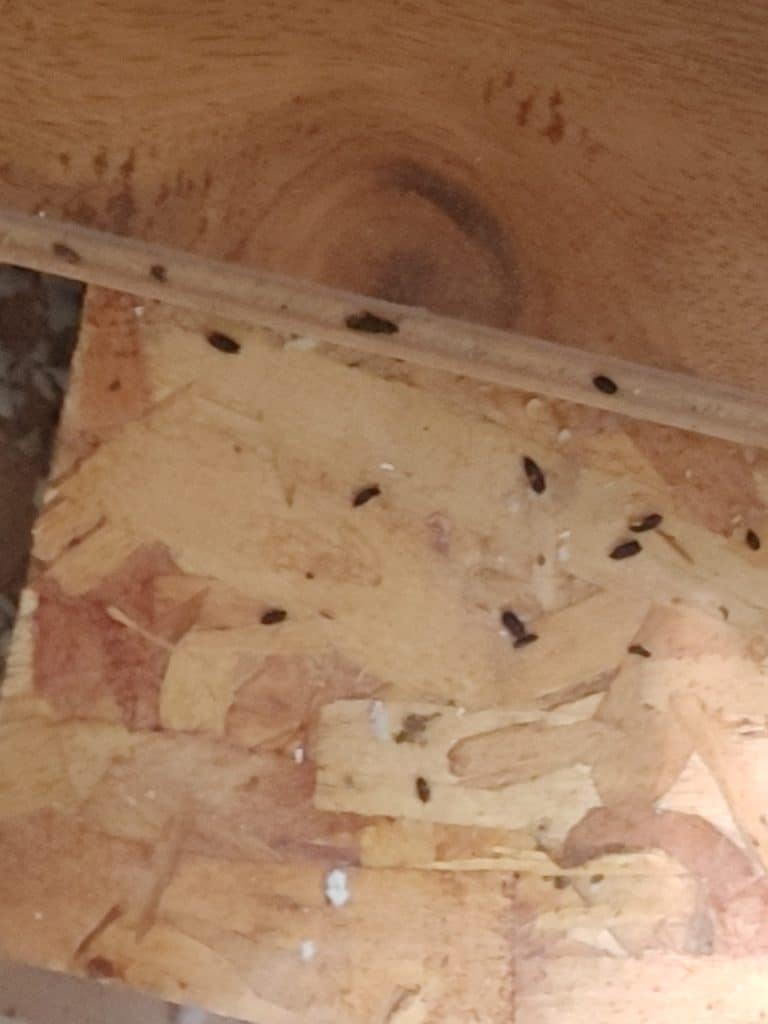
Mouse droppings are dark black, pellet-shaped, and roughly the size of a grain of rice. Fresh droppings are soft; older ones harden and turn brownish gray. You’ll find them concentrated near food zones, under shelving, and along walls. Mice follow the same paths repeatedly, so droppings cluster rather than scatter randomly.
Gnaw Damage
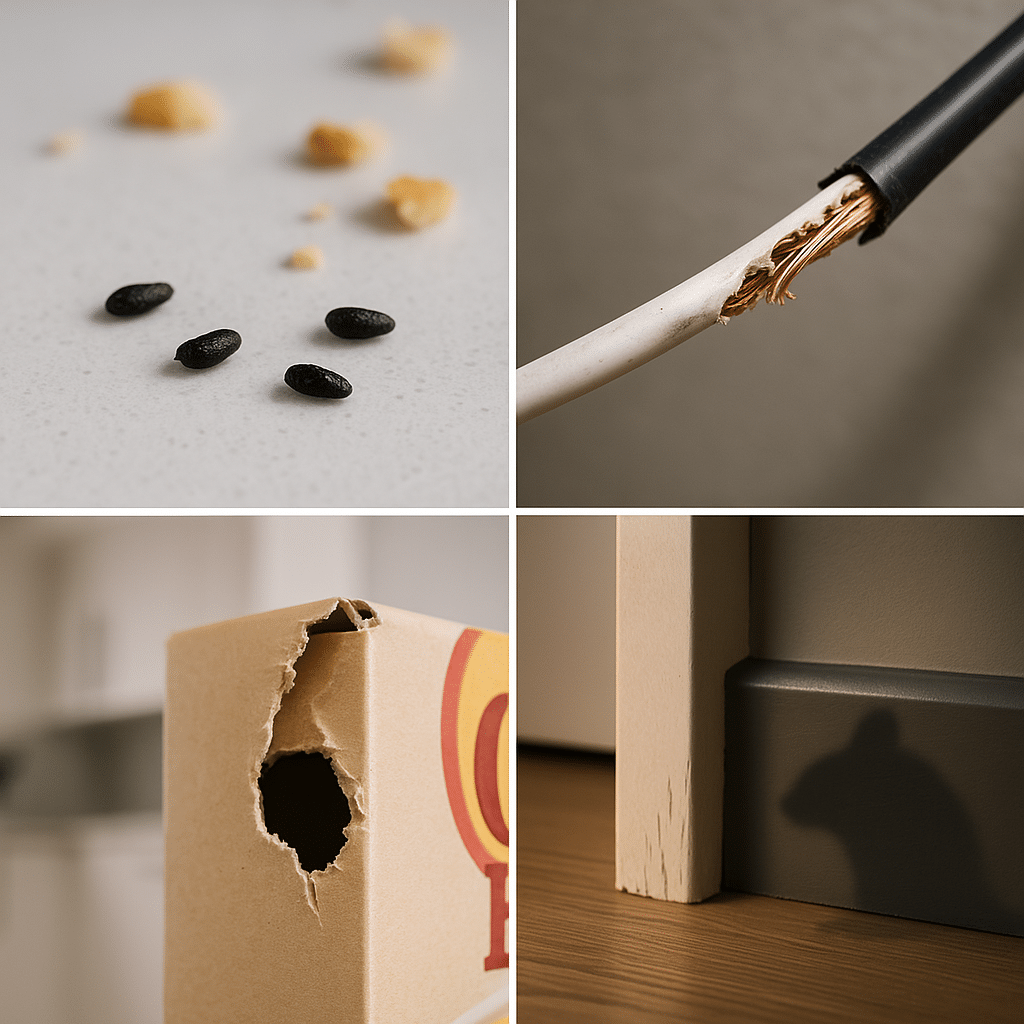
Look for chewed corners on cardboard boxes, gnaw marks on wooden pallets, and frayed wiring insulation. Mice chew constantly to keep their incisors worn down, so damage is always ongoing. Chewed electrical wiring in particular is a fire hazard that sometimes goes unnoticed until equipment fails to start.
Sounds and Smells
Scratching or scuttling sounds in walls and ceilings are most noticeable during quieter night shifts. A concentrated ammonia-like odor in a specific zone, especially behind shelving or under equipment, usually indicates an active nest zone nearby.
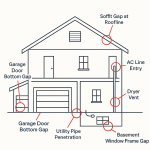
Sealing Entry Points: The Work That Actually Stops Re-Infestation
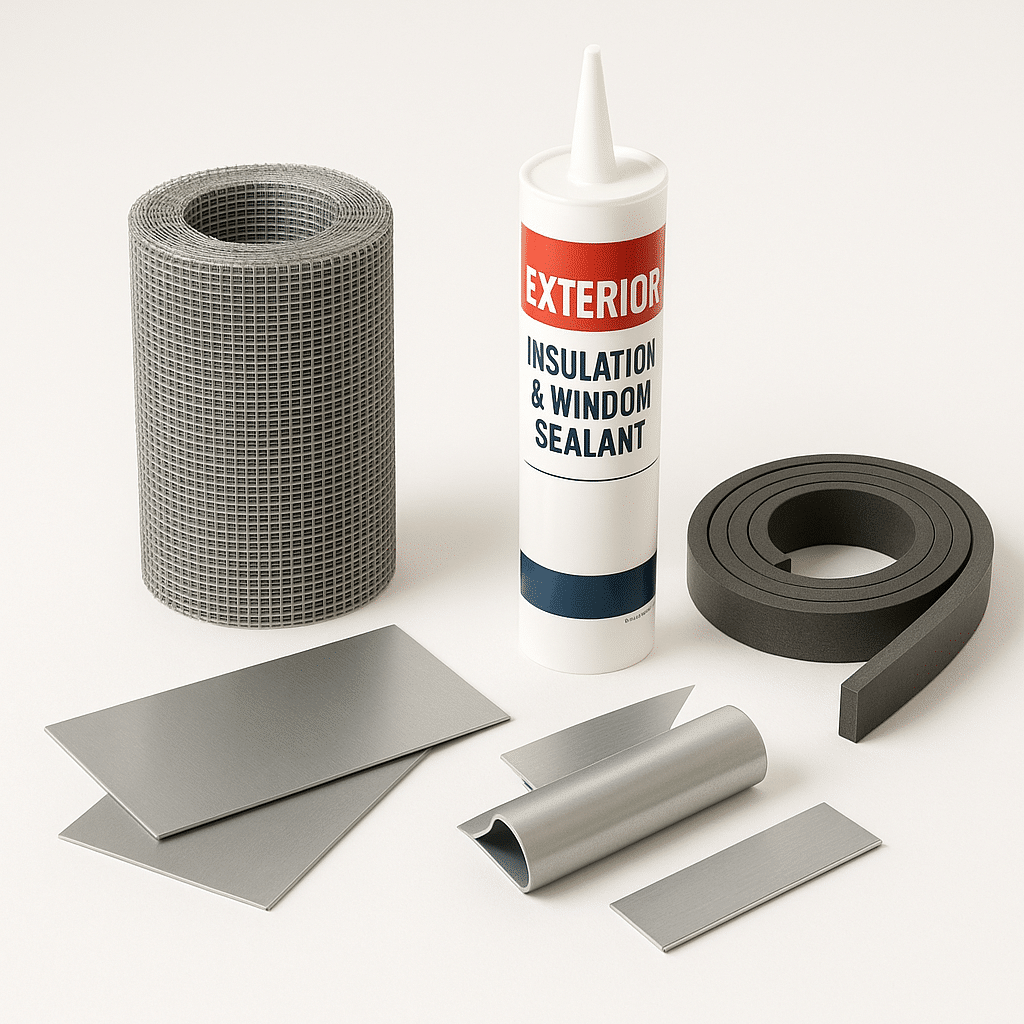
Traps and bait stations catch mice that are already inside. Exclusion work is what prevents the next attacking wave. A mouse needs a gap of only about 6–7 mm (roughly a quarter inch) to squeeze through; that’s smaller than most people expect, and it means standard weatherstripping or strong foam sealant is often insufficient, since they can chew it easily.
Priority areas for exclusion in a commercial warehouse:
- Loading dock doors and dock levelers: gaps at the base and sides are common entry points even when doors appear closed
- Utility penetrations (conduit, plumbing, gas lines) that pass through exterior walls are often sealed with foam that mice can chew through.
- Foundation cracks: especially where settling has occurred
- Roof-line gaps: where roofing material meets the wall, and any damaged soffit panels
- Vents and exhausts: replace mesh screens if the openings exceed 6 mm.
For sealing, use quarter-inch mesh wire or strong steel wool packed into gaps followed by caulk or metal flashing, NOT foam alone. Mice can chew through foam filler in under a minute. Door sweeps on loading dock personnel doors should make full contact with the floor with no daylight visible underneath, and they should be “metal sweeps,” not brush or plastic.
Control Methods That Work at Warehouse Scale
Once you have an active infestation, exclusion alone won’t solve it quickly. You need to reduce the population inside while your exclusion work cuts off reentry.
Snap Traps
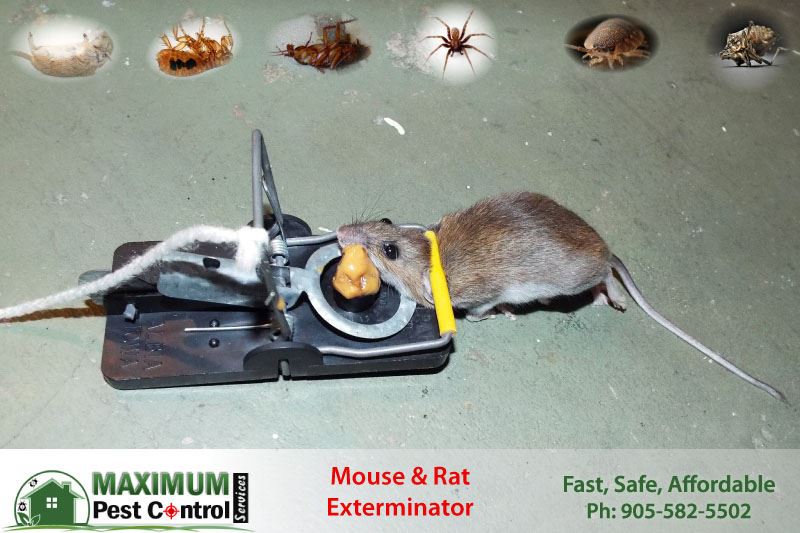
Snap traps remain the most effective option for rapid knockdown. Place them flush against walls and along the edges of racking; mice travel in contact with vertical surfaces rather than crossing open floor space. Peanut butter or hazelnut spread outperforms cheese in warehouse settings. Check and reset traps every 24–73 hours; devices that aren’t checked promptly lose effectiveness and create sanitation problems that invite other crawling bugs.
Bait Stations

Tamper-resistant bait stations containing rodenticide are appropriate for larger warehouses where trap checking across the entire facility isn’t practical. Station placement matters: put them every 8–10 meters along exterior walls and in areas of known mice activity. All bait programs in commercial settings must comply with local Ontario regulations; in food storage or pharmaceutical warehouses, some rodenticide products are restricted or prohibited outright. Work with a licensed pest control operator to confirm compliance. Maximum Pest Control Services (905-582-5502) handles commercial bait programs across Oakville, Burlington, Hamilton, Milton, and Mississauga and can confirm what’s permitted under the Ministry of the Environment (MOE) and the Pest Control Products Act (PCPA) for your specific facility type.
Electronic Monitoring
Connected monitoring devices and sensors that detect rodent activity and send alerts are increasingly common in large distribution centers. They reduce labor on inspection rounds and create a data record useful for compliance audits. The data also helps identify persistent hotspots that need additional exclusion work or more trap density.
Sanitation: Removing What Keeps Mice Coming Back
You can seal every crack and set traps wall-to-wall, but if your warehouse is providing food, water, and shelter, you’re fighting uphill. Sanitation isn’t glamorous, but that’s what makes everything else work better.
- Store all food products—including employee snacks and food break room items—in hard-sided, sealed containers. Don’t leave food in cardboard overnight.
- Empty trash bins daily in any area where food waste is generated, including lunch break rooms, vending areas, and receiving offices.
- Sweep or vacuum along the base of racking in low-traffic zones at least weekly. Debris accumulates in these areas and provides both food and nesting material.
- Check for water sources: leaking pipes, standing water under docks, and HVAC condensate drains. Fix them promptly.
- Move pallets off the floor periodically to eliminate nesting cavities beneath stacked inventory.
Building a Long-Term Prevention Program
One-time interventions don’t hold correctly. Rodent pressure against any commercial facility is continuous; mice probe the perimeter repeatedly looking for new openings. The warehouses that stay rodent-free treat pest management as an ongoing operational process, not a reactive emergency only.
What a sustainable program looks like in practice:
- Monthly perimeter inspections—walk the exterior looking for new cracks, damaged door seals, and vegetation growth against the building (which provides cover for rodents approaching the structure)
- Quarterly interior audits reviewing trap catch records, bait station consumption, and staff-reported sightings
- Staff training so that employees know what to report, how to store items properly, and what not to do (leaving food at workstations, propping dock doors)
- A documented pest management agreement with a licensed exterminator, including response time guarantees for active infestations—Maximum Pest Control Services (905-582-5502) offers commercial warehouse contracts across Oakville, Burlington, Hamilton, Milton, and Mississauga, with guaranteed response times and full service documentation provided
- Records of all inspections, treatments, and corrective actions—these are required documentation for food safety certifications
If your facility operates under a food safety standard, your pest control records will be reviewed during audits. Gaps in documentation, even if you had no infestations, can result in non-conformances, which may lead to penalties or loss of certification during audits. Keep a pest log with dates, findings, and actions taken.
Who Regulates Pest Control in Ontario Warehouses
Warehouse managers in Ontario answer to more than one regulatory body when it comes to pest control. Knowing which agency covers what—and what they look for during an inspection—helps you build a program that holds up under scrutiny rather than scrambling after a violation.
Canadian Food Inspection Agency (CFIA)
The CFIA is the primary authority for food storage and distribution facilities operating under the Safe Food for Canadians Regulations (SFCR). During audits, inspectors specifically check whether your facility has a written Preventive Control Plan (PCP) that addresses pest management—including how rodent activity is monitored, how findings are documented, and what corrective actions were taken. A PCP with no pest control records, or one that shows gaps in inspection history, is treated as a non-conformance even if no active infestation is found.
Ontario Ministry of the Environment, Conservation and Parks (MECP)
The MECP regulates how pesticides are sold, stored, used, and disposed of in Ontario under the Pesticides Act and Ontario Regulation 63/09. This is the legislation that determines which rodenticide products require a licensed exterminator to apply and which can be used by facility staff. Using a restricted pesticide without a license, or storing rodenticide bait improperly, can result in fines under provincial law—separate from any federal food safety penalties. If you’re unsure whether a product your pest control provider is using is licensed for commercial use in Ontario, ask to see their MECP exterminator license before work begins.
Toronto Public Health (and Regional Health Units)
Public health units conduct inspections of food premises to verify they are free of pests and conditions that attract them. In the Greater Toronto and Hamilton Area, this includes warehouses that handle, store, or distribute food products at any stage. Inspectors look for physical evidence of rodent activity, such as droppings, gnaw marks, and nesting material, as well as structural vulnerabilities like unsealed gaps and damaged door sweeps. A failed inspection can result in a compliance order, a public posting of the violation, or a temporary closure order for serious findings.
Health Canada—Pest Management Regulatory Agency (PMRA)
All pest control products sold in Canada are registered by the PMRA, a federal entity, in accordance with the Pest Control Products Act (PCPA). It also runs a Pesticide Compliance Program that monitors whether registered products are being used according to their label—which is a legal requirement, not a guideline. In a warehouse context, this matters when pest control operators apply rodenticides: the label specifies placement requirements, bait station specifications, and restricted-access conditions. Using a PMRA-registered product outside its label conditions is a federal offense, regardless of whether the product itself is legal to apply.
Don’t Wait for the First Sighting to Make the Call

Most warehouse managers call a pest control company after they find droppings. By that time, the infestation has already taken hold, the cleanup becomes more complex, and the expenses escalate. The managers who avoid that situation entirely are the ones who set up a prevention program before there’s anything to react to.
That’s exactly where Maximum Pest Control Services comes in. Rather than showing up when things are already bad, they work with warehouse operators in Oakville, Burlington, Hamilton, Milton, and Mississauga to build a preventive program that keeps rodents out from the start: routine perimeter inspections, properly placed monitoring stations, MECP-licensed technicians using only PMRA-registered products, and the full-service documentation your CFIA auditor or insurance provider will ask for.
A monthly program starting at $150 Canadian costs less than replacing one pallet of chewed inventory. It costs far less than a CFIA corrective action order. And it costs nothing compared to the liability of a rodent finding during a customer audit.
If your facility doesn’t currently have a documented pest management plan in place, that gap is worth addressing today, not after the next inspection. Contact Maximum Pest Control Services at (905) 582-5502 to schedule a commercial facility assessment. No pressure, no contract required for the initial visit, just a clear picture of where your warehouse stands and what it would take to keep it rodent-free.
FAQ SECTION
Does one mouse in a warehouse always mean there are more?
Not always—but the odds are not in your favor. Mice are friendly social animals and rarely travel alone. If you spot one during daylight hours, that’s especially significant, because mice are nocturnal by nature and usually only come out during the day when the population is large enough that competition for food pushes them into riskier territory. A single sighting at night could still be a lone straggler that came in on a delivery. Either way, treat it as a confirmed problem and set traps immediately rather than waiting to see if more appear.
How fast can a mouse infestation grow in a warehouse?
Faster than most people expect. A female mouse can produce 5–10 litters per year, with 4–6 pups per litter. Those pups reach sexual maturity at around 6 weeks old. In a large warehouse with plenty of food and undisturbed nesting areas, a pair of mice can theoretically become dozens within a few months. This is why the first sighting matters so much; a two-week delay in responding is not a minor setback, and it’s the difference between a containable problem and a serious infestation.
What happens if a health inspector finds mouse evidence in my warehouse?
It depends on the type of facility and the severity of what they find. For food storage and distribution warehouses regulated under CFIA and the Safe Food for Canadians Regulations (SFCR), a rodent finding during an inspection can trigger a warning letter, a mandatory corrective action plan, or, in serious cases, a temporary shutdown order. For non-food warehouses, the consequences are usually tied to provincial health and safety codes—but failing an inspection still creates liability, especially if a customer or insurer learns about it. The most important thing is having documentation that you identified the issue and took prompt, documented action.
Would it be advisable to hire a pest control company, or can we manage it ourselves?
For a small, early-stage problem with a few traps triggered in one area and no visible nesting, in-house management with snap traps and a proper cleanup is often enough. Once you have droppings in multiple zones, evidence of nesting, or any indication of gnawed wiring, you’re better off calling a licensed pest control operator. Maximum Pest Control Services 905-582-5502 specializes in commercial warehouse programs serving Oakville, Burlington, Hamilton, Milton, and Mississauga and can assess whether you need a one-time treatment or an ongoing IPM contract. They have access to rodenticide formulations and monitoring equipment that isn’t available in retail stores, and they can provide the signed service records that food safety audits and some insurance policies require. A monthly IPM contract with a licensed commercial pest company typically runs between $150 and $249 CAD, far less than the cost of a single contaminated product recall.
Can mice damage products that aren’t food?
Yes, significantly. Mice don’t only target food packaging; they chew through cardboard, foam insulation inside electronics, rubber wiring insulation, plastic film, and even thin metal foil. In automotive parts warehouses and electronics distribution centers, rodent damage to product packaging or components can result in customer returns and warranty claims where the root cause isn’t immediately obvious. Chewed wiring inside racking systems or machinery is also a documented fire risk. Any warehouse storing goods in cardboard, plastic, or foam has something worth protecting.